
by Cortney Sanders
On May 8, the Levy Economics Institute of Bard College convened its annual conference marking 40 years since the Institute’s founding. The occasion drew a distinguished assembly of economists, journalists, and policymakers united by a shared conviction that conventional economics has consistently failed to reckon with the realities facing the global economy and working Americans.
The keynote was delivered by William H. Janeway, distinguished affiliated professor at Cambridge, veteran venture capitalist, and cofounder of the Institute for New Economic Thinking. Professor Janeway has a significant connection to Levy. In 1986, Hyman Minsky—Levy senior scholar and foremost expert on financial instability—asked Janeway to address the American Economic Association. Forty years later, Janeway returned the gesture, opening a conference devoted to Minsky’s enduring relevance for scholarship, teaching, and research in the field of evolutionary institutional economics.
The event’s panels brought together leading voices in economics. Former FDIC chairwoman Sheila Bair joined Bloomberg’s Tom Keene in conversation on the next financial crisis. John Cassidy of the New Yorker moderated the opening session on AI and the US economy. Isabella Weber of UMass Amherst and James Galbraith of the LBJ School at the University of Texas, Austin discussed the global energy crisis and China’s domestic price stabilization policies. Finally, Levy Institute President Pavlina Tcherneva spoke alongside Darrick Hamilton, chief economist of the AFL-CIO and economic adviser to NYC mayor Zohran Mamdani, on employment and economic security–moderated by Cortney Sanders, Director of National Jobs for All Network.
“The inescapable reality — the single most defining feature of our economy — is that it no longer works for most Americans,” Tcherneva said: “Everything else follows from this.”
Tcherneva’s opening address was both retrospective and strategic. She traced four decades of the Institute’s real-world impact: predicting the private-sector debt bubble, calling the 2008 housing collapse before it arrived, and anticipating the doubling of central bank balance sheets. Since then, Levy has become a go-to source on financial instability and monetary policy, its influence reaching from the US Congress and European Parliament to the highest levels of the Chinese government, shaping legislation, stabilization policy in Greece, and methodological work by the US Bureau of Labor Statistics and international statistical agencies.
Looking ahead, Tcherneva identified two research and policy priorities: economic security for American families and the financial architecture on which that security depends. “Finance must be checked and economic security must be built — those are the twin pillars of Levy’s agenda.” Professor Tcherneva sounded an alarm on GENIUS/STABLE coin legislation, anticipated a paradigm shift under incoming Federal Reserve Chair Warsh, and called for a fundamental rethinking of the 21st-century job—encompassing paid leave, childcare, healthcare, and retirement security alongside direct job creation.
The conference also celebrated the Institute’s graduate program and inaugurated the Levy Alumni Impact Award, presented to Oscar Valdés Viera, Senior Economist at Americans for Financial Reform, recognized for his work on private equity’s threat to retirement accounts. Forty years on, Levy’s ideas have never been more central to economic debate — and the work of the next four decades has already begun.
National Jobs for All Network was very well represented at the Conference. Featured speakers Pavlina Tcherneva, Darrick Hamilton, and Randy Wray are board members of NJFAN. In addition Cortney Sanders Director of NJFAN and Trip Powers, a new member and outreach volunteer, was in attendance.
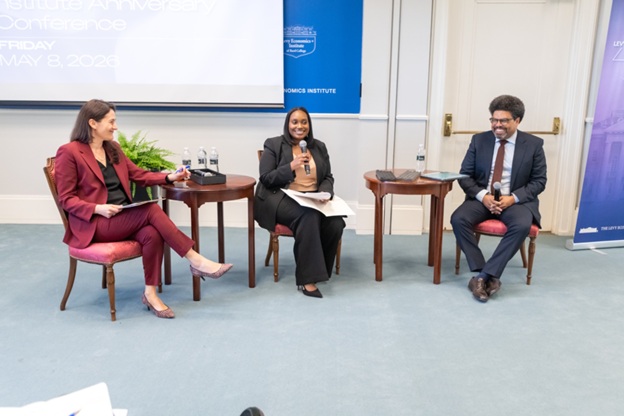
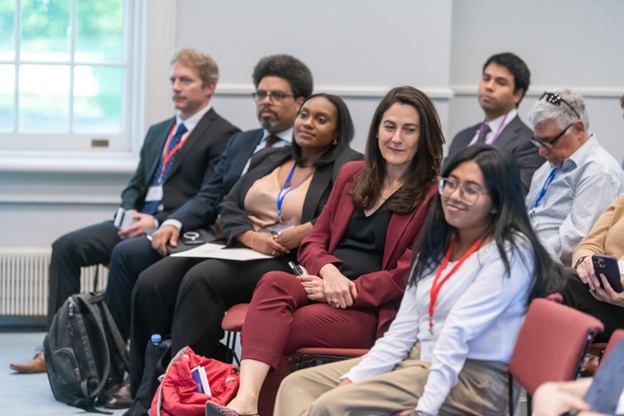
May 8, 2026 Levy Economics Institute 40th Anniversary Conference
Photos by Karl Rabe for the Levy Economics Institute of Bard College